
nano

A smarter way to keep produce fresh on your countertop.
Nano is a countertop fruit preservation system that manages airflow and humidity to slow ripening and reduce spoilage. Designed for everyday kitchens, to help fruit stay fresh longer, cuts down on food waste, and keeps produce visible and ready to eat.
Year
Fall 2025
Timeline
11 weeks
Credits
Rob Watters, Shrikar Vempati
Problem
Produce spoilage is a global resource issue that often starts right on the kitche counter. Nearly one-third of all produce is wasted, costing about $940 billion annually and contributing to 11.8% of global greenhouse gas emissions.


Research

Ethylene gas is the natural plant hormone that triggers and accelerates fruit ripening. As fruit ripens, it releases more ethylene, creating a chain reaction that speeds up spoilage in nearby fruit. Fruits with thin or damaged peels lose moisture faster and are more vulnerable to microbes and oxidation, causing them to break down and spoil sooner.
Market Analysis

Fruit Bowls
✔ Easy access & visibility
✔ Decorative
✕ No freshness control
✕ Fruit overripens quickly
✕ Increased mold & spoilage
Refridgerators
Industrial Scrubbers
✔Extends shelf life for many fruits
✔ Controlled temperature
✔ Advanced preservation features
✔ Precise environmental control
✕ Not ideal for all fruits
✕ Hidden storage
✕ Ethylene gas still accumulates inside drawer
✕ Large, industrial scale
✕ Expensive
✕ Requires power & maintenance
Alternative Preservation Opprotunity
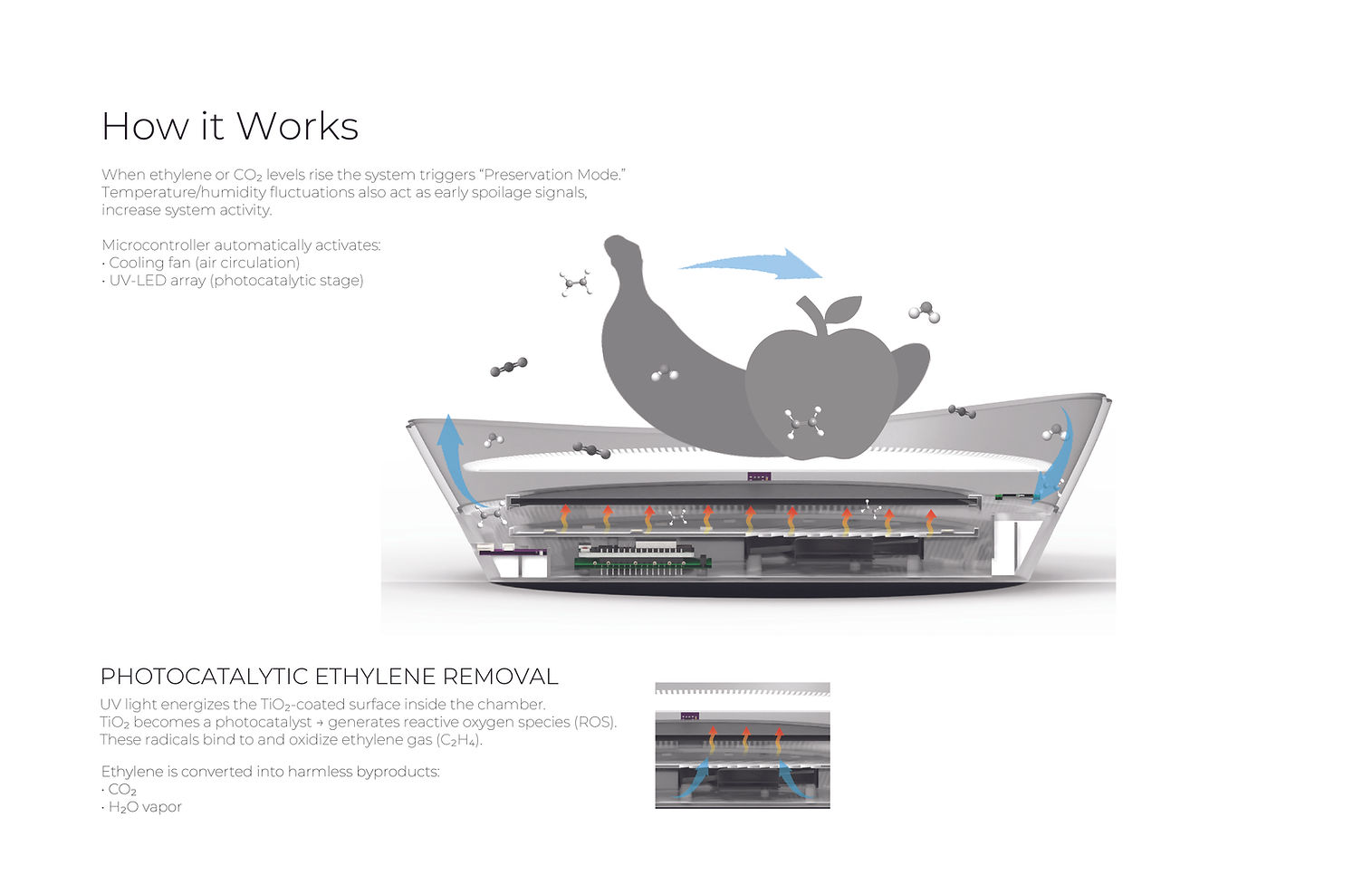
Photocatalytic oxidation uses titanium dioxide (TiO₂) and light to break down harmful gases in the air.

When light hits the TiO₂ surface, it produces reactive molecules that oxidizes ethylene and other volatile compounds, turning them into harmless byproducts like water (H₂O) and carbon dioxide (CO₂). This can be used on fruits to slows ripening and clean the surrounding air, reducing mold and bacterial growth.

"I want to eat healthier, but I don’t want it to feel like more work."
Who
Alex
Late 20's
Urban professional, lives alone, health-conscious
Main Goal
After buying fresh fruit each week, I want it to stay fresh and visible on my countertop so I can snack healthier throughout the day without changing my routine or adding extra steps to my kitchen habits.
Pain Points
I struggle with this because fruit left on the counter ripens and spoils quickly, while storing it in the fridge causes it to be forgotten. Existing fruit bowls focus on appearance rather than preservation, forcing me to choose between freshness and convenience.


_edited_edited.png)
-
Reduces produce waste by 2- 3x
-
Families spend less
-
replacing spoile fruit
-
Extends produce life so groceries last longer
-
Stops early ripening and mold growth
-
Helps households throw out fewer produce
-
Supports sustainability goals
-
Breaks down bacteria and mold spores on produce surfaces
-
Reduces microbial growth
-
Maintains quality, freshness, and safety of produce
-
Slows the softening and browning process
Keeps vitamins, antioxidants, and moisture from degrading
Maintains crispness, colour, and aroma
Nano is a Smart Countertop Produce Preservation System that actively slows ripening by removing ethylene gas, the natural hormone responsible for rapid spoilage. Unlike traditional fruit bowls or single-use chemical filters, this system uses photocatalytic technology to continuously break down ethylene into harmless byproducts, creating a cleaner micro-environment around the produce.
By reducing ethylene buildup, the system slows respiration, maintains texture and nutrients, prevents mold growth, and extends the shelf life of produce by 2-3x. Its countertop-friendly design keeps fruits visible and accessible, encouraging a healthier lifestyle while reducing food waste and saving households money.






Ideations
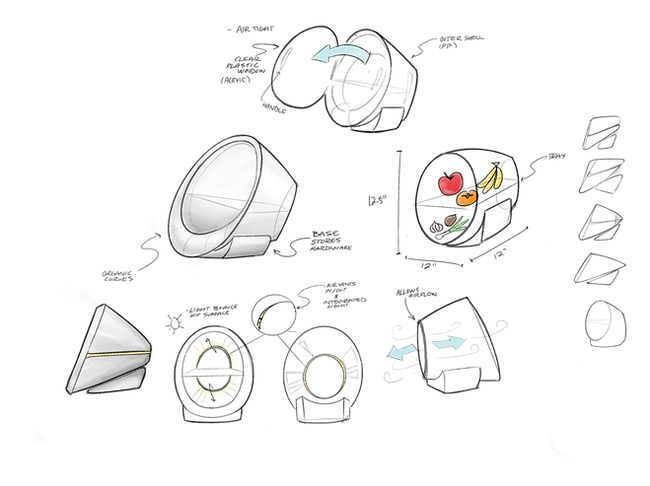
This phase showcases the various concepts and sketches I explored, focusing on developing a system that could effectively open and close while maintaining structural integrity and airflow.
Multiple physical prototypes were created to test form, movement, and assembly. These iterations were built using cardboard, plywood, polyurethane strips, and 3D printing (PLA and TPU). Each material was selected to quickly evaluate different mechanisms, flexibility, and structural performance throughout the design process.
Prototypes
Concept 1
Tiered Dome
Concept 2
Minimalistic Pod
Concept 3
Produce Bin


User Testing
Users liked the idea of a collapsible or origami-style opening but wanted the top to open wider for easier access. Many preferred natural materials such as bamboo or wood for the inner basket, paired with a clear or sandblasted plastic exterior that felt soft, neutral, and smooth.
Most people reported buying around 3–7 bananas per week, plus a mix of apples, pears, oranges, or a Costco-sized clementine bag. Some users, said the product needs to stay compact to fit on small counters, while wanting more capacity. Smaller prototypes tended to squish larger fruits like oranges, showing the need for a slightly bigger internal space.


Manufacturing I
Electronics
I designed a custom PCB to control the internal electronic system and fit within the product housing. After fabrication, I hand-soldered all components, including the microcontroller, power regulation, and sensor connections. The board was tested and integrated into the housing to ensure proper functionality and clean internal layout.


Manufacturing II
I began by 3D scanning the band to use as a reference for accurate CAD modeling. After completing the digital model, I laminated and glued together foam blocks, which were then CNC machined to create a positive mold of the outer shell.


Using this mold, I vacuum formed PETG to produce the lid and side shell. The band, basket, and bottom housing were 3D printed with wood PLA for fast prototyping more complex geometry and precise fit. All components were then assembled and test-fitted to evaluate overall form and functionality.
Testing


